Friday, November 8, 2013

The Theft and Recovery of The Lone Ranger

The worst kind of news any devoted fan of nostalgic pop culture could hear is the theft of archival documents from a public library... especially when the archival materials impairs the valuable and necessary research and documentation of such classics as The Lone Ranger. But that is exactly what happened in the summer of 2013, when a long-time Detroit resident masterminded the unlawful theft of archival historical documents and attempted to sell them on the internet.

Because of the rising incidence of library theft and mutilation of library materials -- most likely caused by the recent economic decline -- public libraries have been suffering serious losses of books and other property. Radio research has taken a massive step up the evolution scale as a result of the internet (provided researchers use the internet as a tool for research, not as a reference). Archival materials in libraries have been making the transfer to digital format as a means of preservation (provided the backups are stored off-site, else that loses the point of "preservation"). But there are still hundreds of thousands (potentially millions) of items that have never been digitally scanned and are still susceptible to theft.

Earle Graser contract for sale
In late June 2013, Hake's Americana and Collectibles Auctions in York, Pennsylvania, officially launched the sale of the "WXYZ Archives," offering boxes of vintage collectibles ranging from The Green Hornet, Challenge of the Yukon and The Lone Ranger. Included among the lot were employment contracts signed by the actual staff of WXYZ (Brace Beemer, Earle Graser, etc.), glossy photographs, promotional premiums, unpublished manuscripts, newspaper comic strips and more. The weekly SCOOP newsletter announced the "WXYZ Archive" and naturally, this caught my attention. I was aware of the George W. Trendle Archive, the Brace Beemer Archive, the Fran Striker Archive, the Raymond Meurer Archive, and other collections housed at public and university libraries, and private collections of family relatives. But what exactly is the WXYZ Archive and why did they have three factual errors wrong in their write-up? Turns out a resident of Detroit, Michigan, consigned his private collection to the auction house in the hopes of making a profit. But the collection was not his...

The auction caught the eye of a number of collectors, including a friend of mine in Brooklyn, New York, Alex, who called me over the phone to inquire about The Green Hornet comic strips (reprinted on my blog HERE). They were for sale and he wanted to know the estimated value. I provided Alex and exact details of why the comic strip never went to print, how many rough sketches were made, the estimated value and other details that were not provided on Hake's auction site. Since only two were made and I know where the two reside, what puzzled me is where this third one originated. Even more puzzling was a number of other collectibles that had two similarities -- they contained autographs of George W. Trendle or "To George W. Trendle" and all of them were among the inventory list in the George W. Trendle Archive, housed at the Detroit Public Library.

The Green Hornet newspaper comic strip
A few years ago, Terry Salomonson, Chris Holm and myself had photocopied eighty to ninety percent of the documents, letters, correspondence, inter office memos, contracts, financial papers, photographs and other materials related to The Lone Ranger and The Green Hornet housed in the George W. Trendle papers at the Burton Collection of the Detroit Public Library. For researchers like myself, photocopying the materials and filing them away for future ease is extremely beneficial. What can take four days copying 20,000 sheets of paper can take six months organizing, analyzing and typing into a book manuscript. Sitting in the reading room and typing information directly into a computer is only feasible when the amount of material does not exceed 40 to 50 sheets of paper per day. 

From a researcher's end, the copy policies at libraries vary and researchers often contact the libraries in advance regarding copy limits, fees, advance permissions, etc. This helps plan and map out a research schedule. (Or as I often say, research entails legwork -- not consulting prior published reference guides and internet websites.) Personally, I have a damn-the-cost attitude when it comes to research, choosing the more expensive route, knowing in the short few hours I have at a library I can go home with more material than I can process in the short time reviewing the same papers at the library. (This is generally why more than half the books I wrote cost me more than $12,000 in research expenses alone.) Having conducted research at more than 100 libraries in the past decade, I can state that my favorite are those with low copy fees (10 cents vs. 25 cents) and no copy limits. (The Billy Rose Theatre Collection at the Lincoln Center for Performing Arts at the New York Public Library has the worst policy anywhere -- their policies and staff do more to handicap your research then help.)

Researchers are responsible for the accuracy of the descriptions of the items sold on auction houses and auction houses make an effort to contact those researchers to ensure their customers are not being misled as to the validity of the item.

Reviewing the items for sale on Hake's auction (link cane be found HERE), a number of them caught my attention. Ink blots, coffee stains, torn corners, carbon copy blemishes, rusted paperclips and other signs can individually brand any archival document. It was those same tell-tale signs that caught my eye. After examining the items for auction and comparing the photographs to the copies in my files, you can imagine my surprise when the blemishes matched  the items being offered on Hake's. Could the items being sold on the web site be the same housed at the library in Detroit? A phone call to Hake's in late July did not confirm my suspicions and the general consensus was that the items were the property of the consignor and therefore the auctions would conclude as scheduled. When I asked an official at Hake's what the policy and procedure is regarding stolen items consigned to the company, I was told "no comment." My next option was to contact the library. After all, the items were probably theirs and they should be notified. After taking down the necessary information, including an e-mail documenting photographic proof, the library staff began an investigation. A police report was promptly filed out with patrol officers, who turned it over to detectives.

John Todd salary contract
Over a period of weeks following, photocopies of the archival documents in my files were scanned and sent to the library at their request; some of the scans were forwarded to detectives in York, Pennsylvania. The staff at Hake's were cooperative with the library and the detectives, even providing the name of the consignor to the library. The library staff began investigating and documenting every visit the library patron made, including every box and file number he reviewed, matching every item being sold on Hake's. A search of the perpetrator's apartment found nothing so we can only hope that all of the stolen items were recovered and not sold prior to this discovery. (Ironically, the perpetrator is quoted on the internet (twice) as a historian and as a preserver of the arts.)

On August 15, the suspect was arrested and charged with larceny from a building. He confessed that all of the material was in fact stolen. He has since been released but not yet sentenced. Hake's has returned everything that was in the auction and will return the remaining materials that they received from this person as soon as they photograph and catalog the items for their own records.

The library has since taken the precaution of installing lockers. Researchers are allowed only note-taking items when consulting the Burton manuscripts. All bags, coats, hats, briefcases, handbags, folders, books, newspapers and other belongings must be stored in the locker. Security cameras have been installed throughout the entire reading room, covering every square inch of the room. 
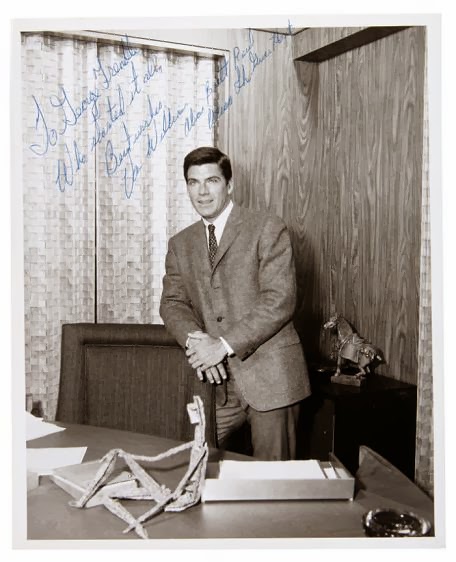
One of the stolen items, autographed to Trendle.
The perpetrator cleared Hake's of any wrongdoing. It should be noted that the internet has granted auction houses such as Heritage and Hake's vast market potential with a virtually unlimited number of buyers as opposed to a brick and mortar building. High-valued items that are too valuable for eBay's marketplace can be found on these type of auction sites. For researchers, these websites offer the occasional treasure such as the existence of a promotional poster unheard of prior, a rare collectible or prototype. Private archives from family relatives grant researchers temporary research potential during the auction tenure, when family relatives were impossible to track down or such collections were not known to exist. (Some theorize the dispersement of archival documents also makes research more of a challenge because the buyers often remain anonymous.) Hake's, like any auction house, provides a contract to every person wanting to sell their valuables and among the clauses is a statement from the consignor attesting to the ownership of the items. The auction houses can only assume the consignor is honest.

This story is not a common one. Theft like this does not happen every day. It is simply an isolated, quickly discovered and remedied incident. But there can be no doubts that many thefts have occurred from other libraries across the country. At an archive last year, a business contract signed by Humphrey Bogart and Lauren Bacall had been discovered missing. Thankfully, a carbon copy of the original contract was still in the collection. Without the carbon copy, the financial records and terms of the contract would have been unknown to historians. In the case of the George W. Trendle Archive, imagine if the stolen items had gone unnoticed and sold to private collectors. Writeups documenting various facets of The Lone Ranger would have gone undocumented. (It has been proven in the past that most people who buy archival items from online auctions have personal agendas and do not cooperate with serious-minded researchers.) 

For researchers hoping to document "the complete story," and fans who enjoy reading such documented findings, with libraries doing their absolute best with security, with auction houses and libraries cooperating to ensure the safe return of archival materials, why are people constantly choosing greed over historical preservation? What can libraries do to ensure that the materials are safe from future raids, and what will they do to provide guidance to similar libraries? 

This story should never deter any parties from donating collections to public or university libraries. No matter what they do with the collection (including storing it in their attic), the threat of fire, water or theft is always a roll of the dice. No matter what security measures are placed, someone will always defy Darwin's theory of evolution by attempting to steal valuable, archival materials from libraries. Stricter policies, procedures and punishments ensure stronger security of the archival documents. But at what cost to the researcher?

Friday, November 1, 2013

War of the Worlds: Rediscovered

Paul Stewart, radio and movie actor
I'm going to keep my comments brief today, making way for Randy Riddle, a collector of old-time radio who recently discovered a new version of the 1938 War of the Worlds panic broadcast. What? A new recording? Sure is. The history of the panic broadcast and the recordings circulating today is too much to include in a single blog post. But thanks to Randy, we have something new to look forward for.

And yes, if this all appears a bit too much "geek," we apologize. But it's way cool!!!

And now, ladies and gentlemen, Randy Riddle.

(clap, clap, clap, clap, clap)

I recently picked up on ebay a six-disc, twelve-side lacquer recorded at 78 rpm of the Mercury Theatre broadcast of "The War of the Worlds." The set is a dub, either from another 78 rpm set or from a 16" lacquer.

Although the set has some sound issues, it does include some very brief parts missing from all of the circulating copies.

Known copies of "War of the Worlds"
A bit of history is in order.  Several posts archived here sum up what we know and don't know about the provenance of existing copies of the program.  CBS, apparently, has an original lacquer of the show - it's unclear if they had transcription recording capabilities "in house" or if it was done "off-site" during the original broadcast.  Michael Biel, in one of the archived posts, talked with an engineer who said he recorded the original discs at CBS when he was new in his job there and was ordered to "smuggle them out" of the studio.

After the broadcast, there are indications that some copies were made for a Congressional committee and/or the FCC, but we don't know the format (16" or 12") or particulars of what discs were made and what happened to them.


We know that another 16" unlabeled lacquer surfaced at an auction in 2001 from the estate of old time radio collector Ralph Murchow.  This green label Presto disc was not authenticated, but sold for $14,000.  It's not clear where the disc originated - it might have been one of the Congressional committee/FCC copies, another copy made at a local station or a dub made from CBS's archive copy.  The type of Presto lacquer was commonly used in 1938, so it could have originated from the period of the original broadcast.  (You can see more info on Presto's early years here.)

All of the circulating copies of "War of the Worlds" originated on a tape that surfaced in 1968.  By coincidence, a tape copy of the program was made for the Library of Congress that year, mono, running 7.5 ips - the source disc used for this tape copy isn't known.  Was it the CBS archive master, the Murchow green label Presto set, or another undocumented version?

Regardless, the copies of "War of the Worlds" circulating now all came from the same tape that surfaced in the late 60s, perhaps a dub of the Library of Congress tape.  The cds in circulation were copied from the lps of this tape that were released in the 1970s and the lp and cd releases have noise gates or other analogue or digital tricks to minimize the surface noise of the original tape.

Background on this set
In this post is a new dub made direct from the 78 rpm 12-sided set that I recently obtained.

According to the seller, it came from a book dealer specializing in rare books and celebrity autographs in the City of Orange, about twenty minutes from Los Angeles.  The set originated in the estate of Jimmy Star, a reporter for the Los Angeles Herald-Examiner and "Film Daily", an industry magazine.

The set has the name "Paul Stewart" written on the cardboard container for the set.  Stewart was one of the Mercury actors who appeared on "War of the Worlds".  He was later a founding member of AFTRA and well respected "behind the scenes" in the Hollywood film community, working in films and television well into the 1980s.

Did Stewart have the set made for reporter Jimmy Star for some reason, perhaps as a gift, a souvenir, or for some story he was working on?

There's no documentation with the set to be sure.  Based on the sound quality, it sounds as if it came either direct from the 16" masters or a really well-done dub of one.

The discs themselves all have white paper labels just like the picture above.  One was a little loose and I peeled it back - the discs are aluminum based and are green label Presto brand.  The set came in Audiodisc "glass base" generic sleeves - the discs themselves could date from near the time of the original broadcast or after WWII.  The disc type - Presto green label - and the way they were cut leads me to think they were done in a professional facility.


The original recording that is the basis for the set appears to be taken directly from the CBS studio or a line from the studio - there's no local station ids, the program is complete, and I don't hear "line noise" indicating it was a "line check" from a local station.  The surface noise is different from the 60s era copy circulating now - perhaps this copy and the 60s tape came from the same disc, dubbed to 78 rpm before it became damaged, or perhaps they came from different copies.

Sound quality and extra material on this set
It's unfortunate that the sound quality of this disc set varies so much on each side, with bright clear sound at the beginning of each of the twelve sides and more muffled sound as the inner groove is reached at the end of the sides. The set also suffers from palmitic acid leaching - a white powder that comes out of the lacquer coating and causes surface noise.  Some parts sound better than the circulating copy; some sound worse.

Despite the varying sound quality, the set is the most complete version of "War of the Worlds" available and includes some brief segments not in the circulating copies.
  • At the 30 minute mark, there's a short extra bit at the part where the announcer says "One moment please ladies and gentlemen … We've run special wires…."  This previously unheard part is some "behind the mic" fumbling by the announcer with another cast member - on circulating copies, this segment got lost in a side change.
For some time, we've been puzzled by a couple of missing lines from the existing recording. 
  • About 40 minutes into the piece where Welles as Professor Pierson says "I look down at my blackened hand…"  In the version that exists, part of the line is missing and sounds like Welles might have not said some of the lines in the published version of the script.  With the missing lines in this new copy, it sounds like the original master used for the circulating copies has a "skip" that was disguised with a bit of editing.
  • At 57:25, there's also a line in the original script not heard on the circulating recordings where Welles says "Strange to see from my window the University spires dim and blue through an April haze."  This might have been another "skip" in the master used for the circulating copies.
  • This new version also includes the original full-length CBS station break, which runs about 15 seconds.  In circulating versions, the silence for the original station break was edited out.
There might be other short bits not in the circulating version that I missed.

Orson Welles at the microphone.
Wrapping up
If you have any thoughts on the possible origins of the disc set or other bits of the show you've never heard before, let me know in the comments.

Our mp3 was dubbed direct from this undated 78 rpm, 12", 12-sided lacquer.  Slight scratch removal was applied to the original file and the "side joins" were edited as closely as possible to the original - each side change of the disc had overlapping sentences or phrases, so you may notice a side change in the middle of a sentence.

Note - This file may take a bit to download.  I've encoded it at a max 128 kps bit rate with the highest quality option.  It's just over 50 mb.  CLICK HERE TO LISTEN

Small added notation: There is enough information to give cause and belief that what Randy has turned up is Paul Stewart's personal copies, which Stewart, may years ago, once told the Cincinnati Old-Time Radio Club that he once owned a recording of the rehearsal for "War of the Worlds."

Thursday, October 31, 2013

Halloween, Hollywood Style

I love Halloween. The time of year when the seasons change, the leaves change colors and an excuse to watch the good ol' horror films with Boris Karloff and Bela Lugosi. My favorite are the Universal monsters like Frankenstein, Dracula, The Wolf Man, the Creature from the Black Lagoon, The Mummy, The Invisible Man... well, you get the idea. And of course, I like to browse through my collection of photographs (and photographs people sent me) of gorgeous Hollywood starlets who also love to celebrate Halloween. Here are a few of them!

Ann Savage

Nancy Carroll

Linda Christian

Virginia Welles
Clara Bow

Elaine Stewart

Jane Adams and Patricia Alphine

And we can't forget my favorite, Veronica Lake


Friday, October 25, 2013

Boris Karloff on "DUFFY'S TAVERN"

Hollywood actor Boris Karloff made a total of three guest appearances on the radio comedy, Duffy's Tavern. His first was on the evening of January 12, 1945. When Clancy the cop says there is a competition among the taverns in New York to sell more bonds than the others, with a major prize in the wings, Archie writes a horror play in the hopes Boris Karloff will star and encourage tavern members to buy war bonds. “Young Monster Malone” tells the story of two mad scientists, Dr. Frank and Dr. Stein, creating a monster (played by Finnegan) known as inflation. (Remember, this was during the Second World War.) A small bit of trivia: The original title of Archie’s play was “A Monster Was Born,” changed during rehearsals. The spoof on radio’s Young Doctor Malone was a better joke, as evident on the original scripts, marked in pencil by Ed Gardner himself.

His second appearance was on the evening of May 21, 1947. Duffy is planning to sell the tavern and sends a real estate man to assess the value of the property. To deter any chance of having the tavern sold to a private investor, Archie, with bats in his belfry, hires actor Boris Karloff to give the impression that the place is haunted. (In payment, Archie offers a zombie drink... a similar joke that concluded a 1941 Information, Please film short.) Archive, however, momentarily suffers from a grave problem when Karloff's theatrics fail to scare the real estate man. Thankfully, Clifton Finnegan enters the room and does the job without any effort.

In the summer of 1951, Boris Karloff accepted an expense-paid holiday to Puerto Rico where Ed Gardner had since made permanent residence. In an effort to evade paying Federal taxes on income, courtesy of a tax loophole, Gardner was by then producing the series in a make-shift radio station on the island. Celebrities were flown down to the island for a combination vacation and radio guest appearance. Gardner, minimizing all costs, recycled the radio script from 1947.

The premiere of the 1951-52 season, which would ultimately be the twelfth and final year for Duffy's Tavern, featured the Karloff broadcast. There were a number of differences between the 1951 and 1947 version: most notably the solicitation and reference of Ed Gardner's recent motion-picture, The Man With My Face, which was presently in theaters courtesy of United Artists. While NBC executives were fully aware that Gardner was recycling radio scripts from past years, and requested new material be used, Gardner temporarily fooled them by providing false information for NBC's publicity department. As a result, the press release from NBC quoted: “Duffy’s Tavern becomes even more ghastly than usual when Ed (Archie) Gardner plays host to Boris Karloff, and attempts to arrange a blind date for Miss Duffy.”

The second episode broadcast for the new 1951-52 season featured Archie exhibiting a swelled head as a result of producing his first motion-picture, The Man With My Face. However, the lineup of celebrities he had invited failed to show for the premiere screening. That cued some amusing banter and supposed phone calls to Dorothy Kilgallen, Leonard Lyons, Louella Parsons, Hedda Hopper, etc., with the realization finally dawning on Archie that he “could not get a line in Louella’s column even if he shot Hedda Hopper.” The cast also talked about what they did during their vacation. Obviously, this episode was intended as the season premiere but NBC, with no financial gain for the motion picture, chose the funnier of the two as the season premiere.

For fans of Boris Karloff, enclosed is the radio script for the 1947 broadcast, with Ed Gardner's original notations on the pages. I didn't want to break the spine as Gardner's original scripts were bound in volumes, so please forgive the crease on the left hand side. Comparing this version to the 1951 is a lot of fun. Enjoy!