Friday, March 18, 2022

THE ART OF PULP FICTION (Two New Coffee Table Books)

With so many books published in a calendar year, a large number of them can slip through the cracks and go unnoticed. So I wanted to take a moment and mention two full-color, hardcover coffee table books that are a feast for the eyes and enjoyable reads with lots of trivia. 


THE ART OF PULP FICTION: AN ILLUSTRATED HISTORY OF VINTAGE PAPERBACKS

By Ed Hulse and Richard A. Lupoff


The Art of Pulp Fiction: An Illustrated History of Vintage Paperbacks chronicles the history of pocket-sized paperbound books designed for mass-market consumption, specifically concentrating on the period from 1940 to 1970. These three decades saw paperbacks eclipse cheap pulp magazines and expensive clothbound books as the most popular delivery vehicle for escapist fiction. To catch the eyes of potential buyers they were adorned with covers that were invariably vibrant, frequently garish, and occasionally lurid. Today the early paperbacks--like the earlier pulps, inexpensively produced and considered disposable by casual readers--are treasured collector's items.

Award-winning editor Ed Hulse (The Blood 'n' Thunder Guide to Pulp Fiction) comprehensively covers the pulp-fiction paperback's heyday. Hulse writes the individual chapter introductions and the captions, while a team of genre specialists and art aficionados contribute the special features included in each chapter. These focus on particularly important authors, artists, publishers, and sub-genres. 

Illustrated with more than 500 memorable covers and original cover paintings. Hulse's extensive captions, meanwhile, offer a running commentary on this significant genre, and also contain many obscure but entertaining factoids. Images used in The Art of Pulp Fiction have been sourced from the largest American paperback collections in private hands, and have been curated with rarity in mind, as well as graphic appeal. Consequently, many covers are reproduced here for the first time since the books were first issued.


Ed Hulse displaying his book with pride.

The other book is...


THE ART OF THE PULPS: AN ILLUSTRATED HISTORY

By Ed Hulse and Doug Ellis


Experts in the ten major Pulp genres, from action Pulps to spicy Pulps and more, chart for the first time the complete history of Pulp magazines—the stories and their writers, the graphics and their artists, and, of course, the publishers, their market, and readers.

Each chapter in the book, which is illustrated with more than 400 examples of the best Pulp graphics (many from the editors’ collections—among the world’s largest) is organized in a clear and accessible way, starting with an introductory overview of the genre, followed by a selection of the best covers and interior graphics, organized chronologically through the chapter. All images are fully captioned (many are in essence "nutshell" histories in themselves). Two special features in each chapter focus on topics of particular interest (such as extended profiles of Daisy Bacon, Pulp author and editor of Love Story, the hugely successful romance Pulp, and of Harry Steeger, co-founder of Popular Publications in 1930 and originator of the "Shudder Pulp" genre). 

With an overall introduction on "The Birth of the Pulps" by Doug Ellis, and with two additional chapters focusing on the great Pulp writers and the great Pulp artists, The Art of the Pulps covers every aspect of this fascinating genre; it is the first definitive visual history of the Pulps.


If either of these two books intrigue you, they can be found on Amazon.com.


I collect more paperbacks than pulps so the first of the two was of extreme fascination for me. I have two bookshelves with more than 500 paperbacks from the 1940s, 1950s, and 1960s. I learned quite a lot about paperbacks that I did not know, making this a reference book worth keeping on my shelf next to those paperbacks.


Friday, March 11, 2022

Friday, March 4, 2022

"1883" is Possibly the Best TV Western in a Decade

If you enjoy raw adult westerns and have not seen Taylor Sheridan's latest now streaming on Paramount Plus, you are missing something truly special. It has been two years since I recommended a new TV series worth watching and five years since I saw a good western worthy of watching and even that series, Godless, streaming on Netflix, was not as high a caliber as this one. 

Sam Elliott in the role of Shea Brennan.

1883 is meant to be a prequel to the popular Yellowstone TV series, but you do not have to see Yellowstone to enjoy this gritty western. The series follows an earlier generation of the Dutton family as they journey from Fort Worth, Texas, to Montana, to establish a ranch and settle down in the savage country that has yet to be tamed. Their journey north and west through the Great Plains toward the last bastion of untamed America as they fled poverty to seek a better future in America's promised land.

The cast includes Tim McGraw, Faith Hill, Sam Elliott, LaMonica Garrett and Isabel May -- the latter of whom provides the narration from her perspective. She sees the true beauty of the land while everyone else encounters hardship, venting complaints and shedding tears. In short, the story really focuses on her character, including her narratives that open and close each episode. While most of the cast have an authentic southern drawl, some have criticized her rendition but she has proven to be the breakout star of the series.

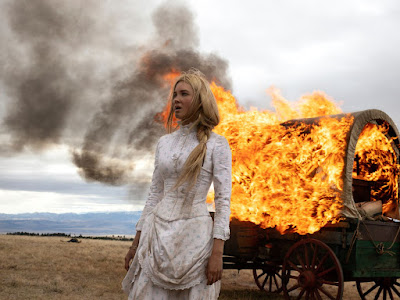
Isabel May playing the Elsa Dutton

The scripts were apparently strong enough to convince a number of celebrity actors to make cameos including Billy Bob Thornton and Tom Hanks. Many in the cast expressed discomfort at the cold temperatures while filming on location in Montana. Faith Hill deemed filming as "the most physically and mentally challenging thing we have ever done." Star Sam Elliott also expressed at his age filming the scenes was difficult, but "we're getting it on screen and in the end that's what matters. This is really going to be something special." Elliott, no stranger to westerns, knew just what he was talking about.

While every actor plays their parts perfectly, with no acting flaws from a single member of the cast, it is Isabel May who steals the spotlight. Her quest for "authenticity" concerning no cosmetics or shaving of underarm hair was evident during certain scenes. Clothes are torn, worn and dirty. Authenticity was called for and the cast and crew spared no expense. One of my pet peeves when watching westerns is when a stagecoach or covered wagon rides across the prairie with a dirt road that was clearly made for that purpose but show no signs of wagon tracks. Here, the tracks are not only evident but deep from past rains.


A warning for those who are not fans of Westerns. The series is raw. A woman is scalped alive and you while the act is seen in the shadows, we are later exposed to the gruesome view complete with blood and bone. As one man said, watching the woman crying in pain, "I don't know the Lord's Prayer, but if there is a God, he will not keep you out of heaven for what I don't know. You deserve peace, and this ain't it." A moment later he pulls his gun and puts her out of her misery. 

Considering this is the second or third TV series in ten years that I place on a list of recommendations, 1883 is truly a feast for anyone who seeks enjoyment. 

Friday, February 25, 2022

THE SHADOWED CIRCLE (Issue #2)

Fanzines have been around for decades and while a large number of them from the 1970s and 1980s are collected these days for historical value, due to their content, the recent addition to the hobby is THE SHADOWED CIRCLE, a fanzine devoted to all things related to the vigilante of pulp fiction and old-time radio.

The first issue was released a few months ago and being a fan of the property, naturally I paid for a subscription. The second issue just arrived in the mail this week and like the first issue it contains articles, profiles, artwork, reviews, and interviews about the pulp-radio-comic book character known as The Shadow.


Reprinting the Table of Contents so you can see what all is included in this issue:

  • Staff, Contributors, & Corrections
  • Editorial: It Takes A Village To Grow A Pulp Journal - Steve Donoso
  • Stories of World History and The Shadow, Part 1 - 1941: Hitler’s Astrologer - Malcolm Deeley looks at how The Shadow was sometimes skillfully blended into world events.
  • Shadow Play - Will Murray reflects on the process and surprises that he and Anthony Tollin experienced in pairing Shadow novels for the Nostalgia Ventures/Sanctum Books Shadow novel reprints. 
  • The Shadow’s New York - Steve Donoso collaborates with the work of noted 20th century photographer Berenice Abbott to create a photo and text essay of New York in the 1930s during The Shadow’s time. 
  • Casting A Long Shadow: The Dark Avenger in Military Heraldry - Tim King discovers Shadowy imagery in the Military and Intelligence Services.
  • Book Review: Will Murray’s Master of Mystery: The Rise of The Shadow - Steve Donoso reviews Will Murray’s recent and fascinating non-fiction volume of Shadow essays and interviews.
  • Comments & Letters
  • The Shadow Laffs - John Sies offers another Shadowed Circle Cartoon.
  • The Shadow: Mysterious Being of the Night - The Pulp Years, Part 1 - Todd Severin and Keith Holt detail the history of The Shadow’s pulp years.
  • The Shadow and The Explorers Club - Julián Puga proposes that The Shadow may very well have been a member of The Explorers Club.

The most fascinating article in the latest issue is Steve Donoso's view of what New York City looked like in the 1930s during the time period these Shadow pulp adventures took place. 

If you are a fan of THE SHADOW, click the link below and buy issue #1 and #2 today.