Friday, September 20, 2013

Dragnet: The "Lost" Premiere Radio Broadcast

Jack Webb as Sgt. Joe Friday
The evolution of detective programs on old-time radio began in the late twenties when most original detectives were inspired by the murder mystery stage plays often dramatized on stage on Broadway. By the early thirties, Philo Vance and Charlie Chan began inspiring imitations and programs of their own... sometimes adapted from the novels themselves -- others to help promote major motion pictures.

In 1946, CBS began offering The Adventures of Sam Spade and those early adventures revealed a different kind of gumshoe -- one who stole money out of a dead man's wallet and shot a crooked thief (a woman) in the back when she tried to escape. Radio listeners (and script writers) took note and began their own imitations of the Sam Spade series, more tame than the Sam Spade character. By 1947, radio detectives became a common staple in network broadcasting -- so much so that concerned parents formed organizations in an effort to curb the vicious murders that intrigued impressionistic young minds. But after you listen to a dozen of those programs -- Philo Vance, Boston Blackie, Nero Wolfe, Richard Diamond, etc. -- the conclusion is the same. The detective programs are relatively the same -- each with their own variation-on-a-theme.

Then came Jack Webb and Dragnet, which was far more original than any detective program on the airwaves. So original that it is difficult to name another radio program that attempted to imitate Dragnet. (It is far easier to name a number of programs that spoofed Dragnet.) Many collectors today know that the first broadcast of the series, June 3, 1949, does not exist in recorded form. There are numerous stories of why that disc was accidentally broken before it could be transcribed but thankfully I was able to find the original script and it is reprinted below for your enjoyment.

Vintage radio advertisement with Jack Webb
A few small notes to point out: the theme song for the first two radio broadcasts was not the classic theme you hear today. It was not until the third broadcast of the series that Webb began using an excerpt from Miklos Rozsa's soundtrack score for The Killers (1947). The second episode of the series does exist in recorded form. Listen to that one beforehand and get a general idea what the theme song was for the premiere broadcast.

There is no origin for the Sergeant Friday character.
The earliest episodes never had an official script title. Some people created their own title for the earliest episodes but be aware that not all of them really had a title -- just because a recording in your collection has a title doesn't mean the information is accurate.

There is a big misconception that the radio program is in the public domain. This is usually stated on websites providing free downloads in an effort to play stupid... and use as a scapegoat should they get into trouble for offering the recordings. The script here is reprinted with permission from the copyright holders.


Friday, September 13, 2013

Shame on the Evening News...

Just the other night I was watching both NBC Nightly News and CBS Evening News and they featured an obituary for a Hollywood celebrity... and the networks decided to include snippets from the actor's motion pictures... with horrible picture quality! For the record, I pretty much stopped watching the evening news a few years ago when I discovered that the majority of the news items are publicizing their own interests (NBC hypes up a motion picture released through Universal Studios, etc.) and most of the news is depressing anyway. After all, is that not why people joke that "there's nothing good on the news" anyway? Why don't they feature up-lifting news items? Anyway, the only time I watch the news now is when my wife calls me in to watch an obituary on a Hollywood celebrity and this is where I am having a issue with.

For more than a year and a half, I have observed where the networks, rather than send a page out to rent a DVD so they can excerpt a clip from the disc, they choose to use YouTube as a venue... forgetting that what looks good on a five inch screen on the computer does not look good when telecast nationwide on larger screens. And such horrible pixeled images are showing up more common on major programs such as Today and Good Morning America. 

Allow me to explain. The picture quality will never be 100% perfect when it originates from YouTube because the video has to be processed and prepared for delivery over the internet, and footage on YouTube (in general) is already compressed down to the smallest file possible so people can watch the clip without waiting for the system to spent an hour downloading the entire film clip. This always entails some loss of quality. For years, news programs used film footage from their libraries when more recent images were not readily available. But the networks now choose to visit YouTube and other internet websites using software to pluck the film clip off the internet. Now, if you plan to do this yourself and have no problems watching the films restricted to a five inch screen on your computer, it will look no different than what you see on YouTube. But blown up on a 40 inch television screen, telecast on the evening news in High Definition, you get picture quality that looks like this (see below).

An excellent example of how it looks on the evening news!
Most people are not ignorant when it comes to old movie footage so when I asked the local news once in an e-mail why this is happening, they claimed the footage was from an old movie and an old movie is always going to look horrible. That is what I call blame shifting. We know the difference between a Super 8, a 16mm and a 35mm nitrate transfer. Saying the old movie footage was just "old" doesn't mean it is going to be pixelated. Anyone who makes a living processing old movie footage from archival prints will tell you that picture quality is dependent on the hardware, software and most importantly... the source material.

Screen capture from a 35mm nitrate archival master.

Screen Capture from a 16mm print, a step down from the 35mm nitrate.

 
Evening News pixeled quality. Imagine this on a 40 inch screen.


What the networks are doing is the equivalent of using footage from a sixteenth-generation print from a 20 year old VHS video. Why not take the extra effort and go to source material that is far superior? Is there not a DVD rental company near by? 

For the record, my wife and I watch television in High Definition. Yes, the system is hooked up correctly and everything is brand spankin' gorgeous. I can even see the sweat coming from the pores on the anchorman's forehead. All the settings on our receiver and television screen is set to perfection. The rest of the evening news is gorgeous. It's only the stock footage they use that looks terrible. There is nothing wrong with the equipment my wife and I use to watch television. And this is just the picture quality -- we haven't even begun with the frame skipping that is common with the method they use to pluck stock footage from YouTube. (And that is the biggest tip-off where their source material comes from.)

On a side note, our local news stations and newspapers in Baltimore, Maryland, won't even promote non-profit events that feature Hollywood celebrities unless we pay them for commercial space -- they won't say that outright, but they word their sentences over the phone in a way that implies this -- and I am not alone. I have complained to the local Chamber of Commerce who verbally told me that they get that complaint too often.

So my question is this.... why would the evening news not want to provide us with the best picture quality when screening excerpts of old movies and television programs? Is this not a bad reflection on the network? Is this not disrespectful to the actor or actress they are trying to recognize?

Friday, September 6, 2013

The 2013 Mid-Atlantic Nostalgia Convention

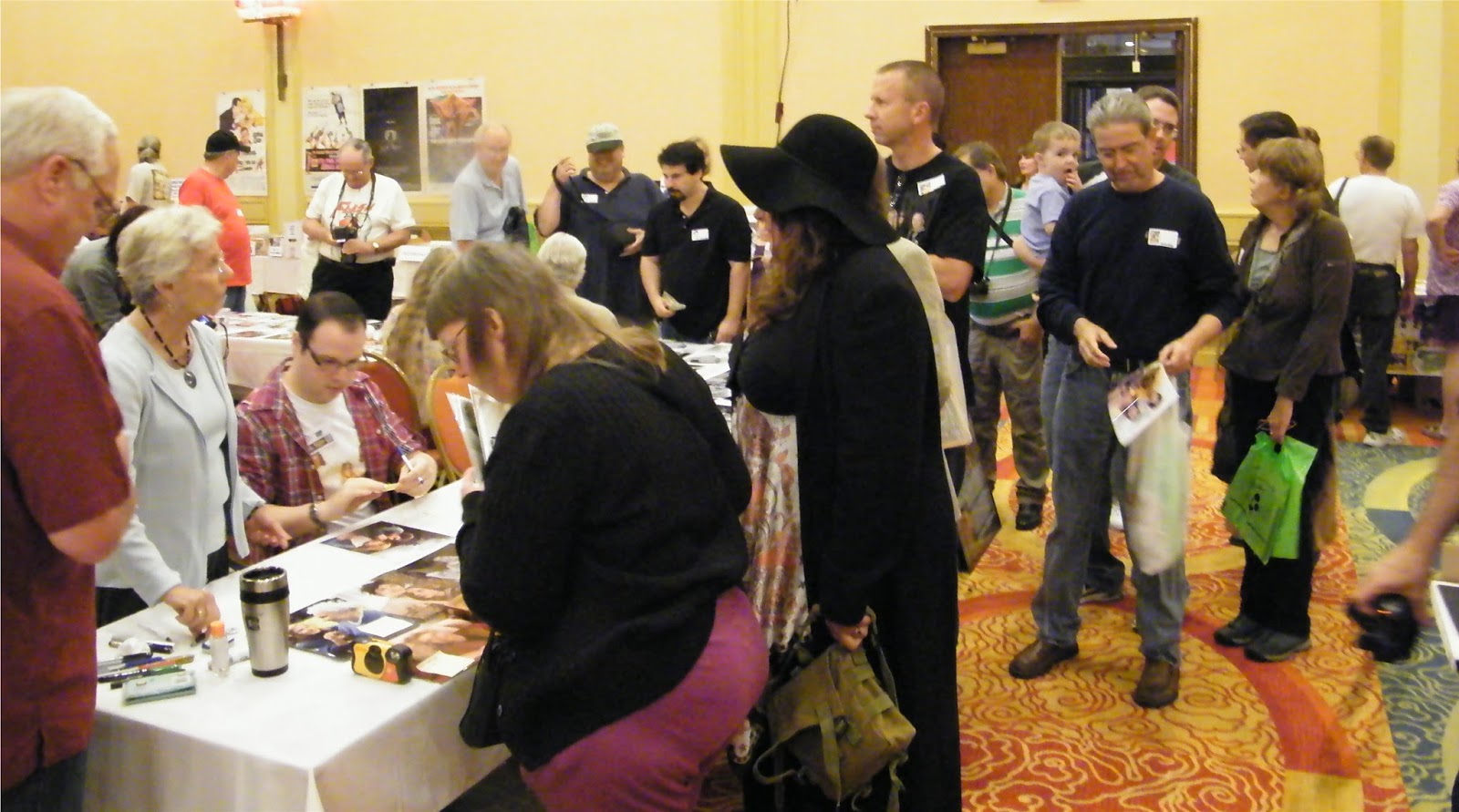
As expected from frequent readers of my blog, here is my annual endorsement for the Mid-Atlantic Nostalgia Convention held annually in Hunt Valley, Maryland. Located thirty minutes from Geppi's Entertainment Museum (next door to Camden Yards) and minutes away from Diamond Distributing (the leading distributor for comic books in the United States), this three-day festival is held at the Hunt Valley Wyndham (formerly the Hunt Valley Marriott) and recognizes the good old days of nostalgia from vintage movies, old-time radio, retro television, pulp magazines, comic books and more.

Patty Duke signs autographs for fans at the 2011 event.

The Mid-Atlantic Nostalgia Convention has a lot going on. Slide show seminars are put on every hour, on the hour. A drive-in movie theater outside the hotel in the parking lot provides a nostalgic look back at the days of outdoor entertainment. Abbott and Costello and Three Stooges impersonators wander the hallways recreating their classic routines. Over 200 vendor tables offering merchandise ranging from tee shirts, books, magazines, movie posters, lobby cards, vhs videos, DVDs, bobble heads, vintage toys and collectibles and more. A movie room screening rare gems from the past 24 hours a day, all three days. Hollywood celebrities sign autographs all weekend and participate in Q&A sessions on stage for fans.

Highlights of this year's event: Garyn Roberts, author of Dick Tracy and American Culture (2003), will provide us a fascinating slide show about the famous comic strip that debuted in October 1931. A special screening of Meet Me in St. Louis (1944) with weekend guest Margaret O’Brien introducing the classic motion picture and answering questions from the audience. Author Cynthia Miller will take you back to the days of the TV rocket men with Buzz Corey, Commando Cody, Tom Corbett and others. Carol Lynn Scherling, the author of Blondie Goes to Hollywood, will provide us a fascinating look at the Blondie comic strip and how it inspired a series of motion pictures during the 1940s. Bob Daniels, the grandson of Brace Beemer, will premiere exclusive excerpts from his up-coming documentary about Beemer, the man who voiced The Lone Ranger on radio for more than a decade. Gene Crowell will host a nostalgic look back at Captain Chesapeake who, for more than 20 years, entertained children on television with his puppet friends.

For anyone who is not aware, the convention (often referred to as MANC) is a non-profit event that helps benefit the St. Jude Children's Research Hospital with a bonus: a charity auction featuring memorabilia donated by Hollywood legends. Check out some of the items up for auction this year!

Rhonda Fleming donated a signed photo!

Valerie Harper's autographed photo for sale!
Johnny Crawford autographed this LP record for the auction!

One intriguing aspect of the show this year is the introduction of video streaming the slide show seminars. This means people who live in Alaska, Canada, California and other areas across the country who otherwise cannot attend the convention due to distance or expenses (airfare isn't getting ay cheaper) now have an alternative. They can watch the events as they unfold live from the hotel. I agree it is not the same as wandering the hallway and meeting and greeting celebrities and vendors and folks who share a common interest... but it's the next best thing. For information all about video streaming at this year's event, CLICK HERE. http://martingrams.blogspot.com/2012/12/manc-announcement-video-streaming-2013.html

Attendees from Belgium, Canada, England and all over the country attend year after year. The attendance has grown in size every year as well. If you stumbled on this blog post and never heard of MANC, I hope the description above convinces you to check it out. I can assure you... I am not steering you wrong.

A recap of last year's event can be found here:
If you want to see a ton of photos (some of them are really cool) from last year's event, click here:
Either way, video streaming or a live personal appearance, I hope to see you at MANC as I haven't missed a single year yet.

Friday, August 30, 2013

Tales From The Crypt Television Series

Tales from the Crypt TV series
Beginning in 1989, HBO telecast a gruesome horror anthology titled Tales from the Crypt, based on the popular 1950s EC Comics of the same name. The series was extremely popular and lasted seven seasons and a total of 93 half-hour episodes. The grisly little horror stories featured ghouls, vampires, werewolves, voodoo, psychopathic killers, zombies and anything you could conceive that pushed the limits. Because it was aired on HBO, a premium cable television channel, it was one of the few anthology series to be allowed to have full freedom from censorship by network Standards and Practices as a result, HBO allowed the series to contain graphic violence as well as other content that had not appeared in most television series up to that time, such as vulgarity, gore and sex. Because of this, the series is not for everyone's tastes but if you love brief horror stories with a bend toward nostalgia, this program is lots of fun.

Tales from the Crypt comic book
EC Comics was originally Educational Comics (if you can believe that) and was founded by Max Gaines, former editor of the comic-book company All-American Publications. Most of the stories featured on the television series were adaptations from one of five comic series -- the four other EC Comics of the time were Haunt of Fear, Vault of Horror, Crime SuspenStories and Shock SuspenStories. With hundreds of stories written, common themes surfaced and this sometimes generated threats of lawsuits: a woman discovering a monkey's paw grants wishes was obviously "lifted" from the 1902 short story, The Monkey's Paw, by W.W. Jacobs. Gruesome versions of Little Red Riding Hood and Hansel and Gretel were depicted. Adaptations of Ray Bradbury science-fiction stories, which appeared in two dozen EC comics starting in 1952. It began inauspiciously, with an incident in which Feldstein and Gaines plagiarized two of Bradbury's stories and combined them into a single tale. Learning of the story, Bradbury sent a note praising them, while remarking that he had "inadvertently" not yet received his payment for their use. EC sent a check and negotiated a productive series of Bradbury adaptations.

A fourth season classic -- who's the dummy now?
The executive producers of the television series were Richard Donner, David Giler, Walter Hill, Joel Silver and Robert Zemeckis, featured on screen in the beginning of every episode. With a fondness for the 1950s, many of the episodes took place during that decade -- vintage automobiles, costumes and art deco aptly placed within the confines of the screen. In "The Secret," a young boy not only has plenty of fifties toys to contend with, but sports a Davy Crockett cap throughout most of the episode. (The same episode also featured a poster of a Buck Jones movie hanging on the wall in his bedroom.)

The ghoulish, twist-filled horror stories tinged on black humor, attracting an A-list of directors and celebrities contributing their talents. Arnold Schwarzenegger not only directed an episode from the sophomore season, but made a cameo in the same. Both Michael J. Fox and Tom Hanks did the same for their episodes as well. Some of the biggest names in Hollywood signed on to play a part of the fright fest, including Demi Moore, Kelly Preston, Dan Akroyd, Joe Pesci, Adam West, Patricia Arquette, Teri Hatcher, Daniel Craig, Ewan McGregor, Bobcat Goldthwait, Elizabeth McGovern, Brad Pitt, Brooke Shields, Donald O'Connor, Margot Kidder, Isabella Rossellini, Isaac Hayes, John Lithgow, Roger Daltrey and Steve Buscemi.

The Crypt Keeper with a Tales comic book.
Jon Lovitz portrayed a struggling actor who would do anything for a part in "Top Billing," Whoopi Goldberg donned the robes of an occult priestess to practice voodoo in "Dead Wait," Mimi Rogers played the role of an aspiring actress who would literally kill for a part, Christopher Reeve and Bess Armstrong were restauranteurs who cooked up a killer recipe made of human flesh, Timothy Dalton was a werewolf hunter on a mission, Larry Drake plays a psychopath who recently escaped an asylum and, dressed like Santa Claus, terrorizes a greedy housewife, and Billy Zane and Martin Sheen played rival magicians who had it in for each other.

Your host for the evening, The Crypt Keeper.
Each episode began and closed with a horror host -- The Crypt Keeper -- an animated corpse, as opposed to the original comics in which he was a living human being. The wisecracking Crypt Keeper, who was voiced by John Kassir, introduced each episode with intentionally hackneyed puns in a similar manner to Raymond Edward Johnson, the host of radio's Inner Sanctum Mystery. In fact, having grown up with the television series when I was a child, I have always envisioned Raymond as an animated corpse when listening to the old-time radio programs. Did I mention that each episode opened with a creaking gate and a creaking door? Hmmmmmm......

Alfred Hitchcock and Forest Gump (The Crypt Keeper)
My wife and I, having spent the past eight months enjoying the series, watching a couple episodes a week, discovered a few gems among the bunch. Humphrey Bogart made a posthumous performance in the episode The episode "You, Murderer," using computer effects to digitally insert the actor into an episode. The technology was relatively new at the time, used to superimpose John Wayne into a soda commercial. The episode was directed by series producer Robert Zemeckis, who had recently directed Forrest Gump which utilized those same effects. Just for fun, Alfred Hitchcock appeared in a cameo at the beginning of the same episode, and yes, Humphrey Bogart played the starring role for a classic murder mystery. The episode also featured Isabella Rossellini parodying her lookalike mother, Ingrid Bergman, for the first (and only) time. Yes, a Casablanca reference was made.

Borrowing a plot from Tales from the Crypt (issue #31), "Korman's Kalamity" featured an employee (Harry Anderson) of a comic book company producing the Tales from the Crypt comic being investigated by an attractive policewoman, who believes his monster drawings are coming to life. (And yes, they were.) The cartoonist had to deal with the biggest monster of all, his shrewish wife. One has to question whether the plot was borrowed from a 1940s radio broadcast of Molle Mystery Theater, later reused on Suspense.

Don Rickles as a ventriloquist with a dark secret.
My three favorite episodes turned out to be "The Ventriloquist's Dummy," directed by Richard Donner, dramatizing the story of a young ventriloquist (Bobcat Goldthwait) who wants to improve his craft and seeks out help from an old hero (Don Rickles), a retired ventriloquist, but discovers his act is terrible. "You have to play the audience," Rickles explains. Ultimately, Bobcat is desperate to discover Rickles' secret and it was here, after a large build-up, I was asking myself just what kind of a twist was in store for me. After all, ventriloquist dummy stories have been done so many times on The Twilight Zone, Alfred Hitchcock Presents and of course, Inner Sanctum Mystery. Could they come up with a twist that hasn't been done before? Oh yeah.... to tell you would ruin the fun. Let's just say if you are going to watch only a few episodes of this series (DVDs are available for rental on Netflix), grab this one!

"Dig That Cat, He's Real Gone" is a great first-season episode involving a scientist who implants a cat's nine lives into a hobo, then uses each of those lives to charge tickets and see a man die -- a gruesome, chilling story that has an ending you won't see coming -- my second favorite episode.

Kirk Douglas and Eric Douglas in the episode, "Yellow."
The other pleasant surprise was the final episode of the third season, "Yellow," starring Kirk Douglas. Set in the final year of World War I, a general's son (played by Eric Douglas) is branded yellow for causing the death of a platoon under his command and sentenced to death by firing squad. The plot might not sound intriguing but trust me when I say that the treat of watching Kirk Douglas reprising another Colonel Dax from Paths of Glory (1957) is only half the fun. The surprise ending made this my second favorite. Just watching these three episodes will make you an addict for more Tales from the Crypt.