Friday, September 16, 2011

THE MYSTERY OF GRETA GARBO

When Swedish film director Mauritz Stiller was brought to the United States by MGM, he insisted on bringing along his protégé, the young Greta Garbo. In the 1926 film Torrent, the 19-year-old Garbo dazzled audiences with her beauty and complex emotions. Her films with silent screen star John Gilbert (and their off-screen romance) made for big box office, and by the end of the silent era she was Hollywood royalty. Garbo valued her privacy, which was respected by the studio heads, who preferred to keep her happy when considering the huge profits that came from her pictures. She may have been a cash cow to Louis B. Mayer, but it might have been her throaty, accented voice that prevented her from speaking before the radio microphone.

On the evening of January 24, 1942, three radio networks (Mutual, NBC Red and NBC Blue) presented The March of Dimes: Hollywood’s Salute to the President, an hour-long gala featuring the unprecedented appearance of the screen idol, Greta Garbo, making her radio debut. Standing alongside a number of celebrities, Garbo made a public appeal for the victims of Infantile Paralysis. The woman who was best remembered for the catch-phrase, “I vant to be alone” (Grand Hotel, 1932), now wanted a few minutes with the American public for a cause that was more important than her solitude.

The January 24, 1942, March of Dimes broadcast aired live 8:15 p.m. PST (11:15 EST) from coast-to-coast. Arch Oboler directed the radio special. The list of celebrities was enormous. Spencer Tracy, Humphrey Bogart, Bing Crosby, Bob Hope, Jean Arthur, James Cagney, Tyrone Power, Ronald Colman, Deanna Durbin, the Merry Macs, Thomas Mitchell, Dennis Day, Jim and Marian Jordan (Fibber McGee and Molly), Edgar Bergen and Charlie McCarthy, Mary Martin, Claudette Colbert, Marlene Dietrich, Ronald Colman, Gordon Jenkins and his Orchestra, a 16 voice chorus, and of course, Greta Garbo.


Mention of Garbo's "first radio appearance" in The Washington Post.

Could Greta Garbo have really avoided the microphone for most of her career until 1942? Could she have possibly done this one and only radio broadcast? While it seems unlikely when you consider the efforts of the Hollywood studios to promote their product whenever possible, encouraging and forcing celebrities to make public appearances, the answer to that question remains a mystery. No one has yet been able to find a radio broadcast with Greta Garbo, other than the March of Dimes special. And there’s a story behind all this. At the premiere of her film The Temptress (1926), the announcer on stage introduced the star by saying, “This is Miss Greta Garbo, from Stockholm. Miss Garbo doesn’t speak a word of English.” Anxious to underscore this point, Garbo chimed in with a firm, “No, not von vord!” The ensuing laughter so embarrassed her that she never attended another movie premiere.

Without intricate details into the affairs of movie premiere coverage on local radio stations, or printed confirmations in the form of radio reviews, we cannot simply assume she participated in the festivities. One such example: When Mata Hari premiered in Los Angeles in January 1932, radio station KMTR pre-empted regular programming for coverage of the gala, with celebrities speaking before the microphone, stationed along the red carpet. No confirmation as yet has been found to verify Greta Garbo was among those who spoke before the microphone that evening.

Without the actresses’ participation, studio executives employed a different tactic. To promote Grand Hotel, one of MGM’s all-star dramas, in which Garbo played the role of a ballerina, the studio commissioned a 30-minute recording titled, The Life of Greta Garbo. Syndicated across the country, Garbo’s voice was never heard. But her biography and screen career were dramatized by another (unknown) actress attempting her best Swedish accent. The transcription apparently featured no closing announcement, which we can only assume was left to the local radio stations to fill in with their staff announcer. This was a shrewd business move on the studio’s part, because the announcer would reveal the day and time of the screening of Garbo’s latest picture, and the name of the theatre. And no doubt that transcription disc included a copy of the announcer’s script, with the proper blanks to be filled in.

The gimmick of having a local staff announcer reveal the location of the theatres in the local area was shrewd. Case in point: One confirmed broadcast was over KHJ in Los Angeles, on April 16, 1932. (The New York City premiere of Grand Hotel was April 12, followed by Los Angeles shortly after.) Weeks after the theatrical release of Queen Christina, the same recording was played over WJSV in Washington D.C., with the local station staff announcer promoting MGM’s latest picture.

The studio also recorded audio tracks from their motion pictures for 15-minute air trailers, paid commercials promoting their various movies. A number of MGM promotional air trailers exist in collector circles, including Camille (1936) and Conquest (1937). The radio audience clearly heard Garbo’s voice, but that was provided by audio tracks from the respective movies.

From February 16 to June 14, 1932, CBS aired a 15-minute weekly program titled, Stories of the Living Great, featuring brief biographical sketches centered on the life of a famous celebrity, from Henry Ford to Marie Dressler. Sponsored by Lehn & Fink Products Corp. (makers of Pebeco toothpaste) and commercial spokeswoman Ida Bailey Allen, this short run program featured New York actors Agnes Moorehead, Alan Reed (a.k.a. Teddy Bergman) and J. Scott Smart in supporting roles. For the broadcast of February 23, 1932, the screen career of Greta Garbo, with cooperation from MGM, was presented. (It still remains unknown who played the role of Garbo.)

On the evening of October 11, 1931, Greta Garbo was scheduled as a guest for The Three Bakers of Hollywood, sponsored by Standard Brands (promoting Fleischmann’s Yeast). This short-run program aired over NBC Blue on Sunday evening. Even the New York Times reported Garbo’s up-coming appearance. After checking everything from the Library of Congress, the surviving records of the J. Walter Thompson Agency which represented the sponsor, files at NBC, and the Billy Rose Theatre Collection in New York City, I have verified that Garbo canceled her appearance before the broadcast and Harriet Hilliard filled in as a guest.

There are three recordings in collector hands that post-date the 1942 March of Dimes broadcast, featuring the voice of Greta Garbo. All three were provided courtesy of the sound tracks from her movies. The April 18, 1954, broadcast of Stagestruck, hosted by Mike Wallace, documented “How the Stage Helped Make Hollywood History.” Numerous celebrities, through exclusive interviews, offered commentary. Mary Pickford, Douglas Fairbanks, Frank Lovejoy and many others. Greta Garbo’s voice is heard, but again only from a movie sound track. The April 25, 1955, broadcast of NBC’s Best of All, featured a salute to Lionel Barrymore with a scene from the sound track of Camille. This means Garbo’s voice was once again provided courtesy of MGM’s film vaults. The April 10, 1957, broadcast of Recollections At Thirty also featured a scene from the sound track of Camille, with Greta Garbo and Lionel Barrymore.

One recording not known to exist is the August 15, 1954 broadcast of Weekend, where Garbo appeared as a guest on the “Woman’s Page” spot, but her appearance was taped in advance and broadcast during the program.

In Closing
Although radio historians are still trying to find confirmation of more than one radio broadcast, it appears (for now) that Garbo’s first and only radio appearance was the March of Dimes broadcast of 1942. Ironic when you consider that Garbo’s technique before the cameras was usually word-perfect on the first take. She was known for making her films quickly. To achieve this result, the very private actress often banished crew members and even the director from her range of sight. Visitors on her sets were strictly forbidden. Yet, the actress somehow managed to set the record for the least amount of public radio appearances in Hollywood history.


Friday, September 9, 2011

Joel Blumberg, Radio Show Host

As he had done a thousand times before, Joel Blumberg was going to work for a Miami Heat radio broadcast of the Knicks game. Over the years, he was in charge of Islanders, Rangers, Knicks, Jets and St. John’s broadcasts. He was also known by many as the longtime voice of Manhattan College basketball. His name may not have been known to the mainstream public as a sports announcer, but his voice was familiar.

On Friday afternoon, December 17, 2010, Joel boarded a Long Island Rail Road train in Merrick headed for Madison Square Garden to work the Knicks game for the Miami Heat radio team. He lived in East Meadow so the trip was routine. But before he reached his destination, Joel suffered a fatal heart attack. He was 64. 

If you’ve listened to a sporting event over the last 20 years, there’s a good chance you’ve been affected by Joel Blumberg’s work. He was considered one of New York’s busiest producers and engineers. “He was a terrific mentor and an even better friend,” said Marc Ernay, assistant sports director, Metro/Shadow Broadcast Services.

“He demanded only that you put all your care and dedication into your work,” remembers Tony Sibilla,  remote broadcast engineer for Blumberg from 1989 to 1991. “He taught me to be ready for anything. That’s a lesson that translates to everything in life.” After showing his dedication as an engineer, Sibilla was finally able to realize his dream—going on the air for in-studio updates during some Islander road games. One day in Chicago, though, he was asked to do color commentary on one broadcast. “I was so floored that he trusted me with that responsibility,” Sibilla says. “It’s a memory that will stay with me forever and I have Joel to thank for it.”

Joel was one of the most versatile people in media. Not only was he a former sportscaster, whose credits include play by play of football, baseball and NCAA basketball and hockey, and the producing of many of the top sports events that have taken place in the last three decades, he was one of the members of the Executive Board of the Metropolitan Golf Writers.

Joel Blumberg was also an avid film buff and historian. His favorite love was film noir and he supplied commentary for a number of DVDs through VCI Entertainment, including Forgotten Noir: Volume 5 and Silver Lode (1954). The latter film was a favorite of Blumberg's, especially since he admired the charisma of John Payne on the silver screen.
 
In the January 2008 issue of Classic Images, an article on character actor Richard Anderson went to press, authored by Joel Blumberg. In September 2006, Joel appeared at the 3-D film festival in Los Angeles and conducted an on-stage interview with Biff Elliott, the star of I, The Jury (1953), following a screening of the film. On the same weekend, Blumberg interviewed James O’Keefe, son of the late Dennis O'Keefe, following the showing of The Diamond Wizard (1954). It was here that Blumberg struck a friendship with O'Keefe, ultimately encouraging Joel to consider writing a biography about the screen actor, with the assistance of his son, James.

In May of 2006, Joel spoke at the 2006 Palm Springs Film Noir Festival. Joel had the honor of interviewing Adrian Booth Brian, formerly screen actress Lorna Gray, who talked of her roles in Serials, Westerns, and Three Stooges Shorts as well as her late husband David Brian. (Joel had been a featured host at the Palm Springs Film Noir Festival since 2005.)

Joel also took his lifelong passion and knowledge of classic movies and went public with it in the form of his acclaimed radio program “Silver Screen Audio” heard weekly on radio station WGBB in Freeport NY, a New York City Suburb. Whether the radio station now offers reruns of the program or simply canceled the series altogether is not known at this time. Thankfully, Joel's web-site (at the time of this writing) is still operating and allowing people to download past radio shows in mp3 format. If you are capable of doing so, record them now before the site goes down. Those interviews are treasured and should be preserved. (Remember, they are copyrighted, so copy them only for yourself!)

Guests on the program have included actors like, Burt Reynolds, Stacy Keach, Biff Elliot, Peter Ford, Marsha Hunt, Christopher Lee, Richard Anderson and Warren Stevens. Also interviewed are the likes of  film historians Foster Hirsch (Otto Preminger), Jeanine Basinger (several books, including the most recent, The Star Machine), Stone Wallace (George Raft), and Alan Rode (Charles McGraw). 

Joel also got involved with the Mid Atlantic Nostalgia Convention beginning in 2009. Having made arrangements for a number of celebrities to attend the convention, Joel asked that he have the privilege of interviewing a couple of them on stage. The request was granted. The following year, the regular interviewer was unavailable to attend and Joel Blumberg filled in for him. He added class to the convention and both staff and attendees began remarking how the convention went up a notch in quality.

"It was my great pleasure to become acquainted with Joel Blumberg at the Mid-Atlantic Nostalgia Convention," remarked Ken Stockinger, a yearly attendee. "While I was aware of his impressive professional resume, what struck me the most was his dealings with all those he came into contact. Whether speaking with a well known celebrity, or a first time convention attendee, all were treated with warmth and respect. After speaking with Joel for but a few minutes, he made you feel as if you were a lifelong friend."

Dennis O'Keefe
For the 2011 event, Gregory William Mank, another respected author and historian, has voluntarily accepted the position Joel Blumberg left behind. Greg has written a number of superb books including Dwight Frye's Last Laugh (1997) and Bela Lugosi and Boris Karloff: The Expanded Story of a Haunting Collaboration (2009). 

Talking on the phone with Joel a number of times, for myself, was a treat. He was a great conversationalist and shared the same passion of classic old time radio movies that I did. He often talked about the games he went to, his daughter Miranda, and the projects he hoped to complete before the end of the calendar year. He was working steadfast on a biography about Dennis O'Keefe before his untimely passing. Sadly, Joel planned to begin typing his book after the holiday.

Thankfully, his first book met fruition in 2010, Lloyd Nolan: An Actor's Life With Meaning, a biography about the actor who could play any character in any genre and was believable in every role. After reading the book, I was amazed to discover Nolan's off-screen life was just as remarkable. He was devoted to his autistic son Jay and, when young Jay died in an accident 2,500 miles away, Lloyd channeled his grief into action. For the rest of his life, he did everything he could to better the lives of disabled people and their families, and such people are still benefiting from the resulting legislation today.

"Joel Blumberg was the perfect co-author for a Lloyd Nolan biography because he was very familiar with Lloyd’s work and had a high regard for the man," recalled Sandra Grabman, his co-author. "The text he added to the book was wonderful, not only telling a bit about the films in which Lloyd appeared, but also their history and remakes. He certainly knew his stuff! It was through Joel that I met Lee Meriwether. [who attended the Mid-Atlantic Nostalgia Convention months prior]. We were in Los Angeles to do some Nolan research, but he had also scheduled a radio interview with Lee. He took me along to Theatre West and let me watch as he interviewed this very lovely, articulate, and kind lady."

"On the personal level, it’s very seldom that one comes across such a generous man," continued Sandra. "Joel learned that I was about to record some audio books, and responded by mailing me a professional microphone and mixer to use. He made himself available at any time, any place, to provide instruction for using them. When I was finished with this equipment, I asked if he’d like for me to return it. His response? 'Keep them. You might need them later.'"

Joel will no doubt be missed, but what he left behind cannot be expressed in words. Classic Images featured an obituary covering his career. And Joel, like anyone who helped preserve a little of the hobby, will be remembered for years to come. Somewhere, up in heaven, he will no doubt be looking down from Heaven and smiling.

Photos below were taken at the 2010 Mid Atlantic Nostalgia Convention and are courtesy of Mike Amowitz. Joel was instrumental in arranging for Marsha Hunt to attend the convention, having flown to California to meet her in person at her house, interview her for another project, and then called me moments after he pulled out of her driveway to tell me she would be coming as a guest. And of course, I could not turn down his request to interview her solo (not among a group of other celebrities). It was standing room only in the back room and the interview was broadcast live over www.RadioOnceMore.com for those who were not able to attend the convention that weekend.

Joel Blumberg and Marsha Hunt. Photo courtesy of Mike Amowitz.

Dawn Wells and Geri Reischl. Photo courtesy of Mike Amowitz.

Taking advantage of this posting, since I made mention of Silver Lode (1954) in an above paragraph, I am offering scans of original publicity photos distributed to movie theaters in 1954. I don't know when I'm going to have a chance in the future to feature a scan of these photos as I don't expect to do a write-up about the movie, considering Joel's commentary on the disc was fantastic and covers all the bases, so enjoy!


Friday, September 2, 2011

The Work of H.J. Ward

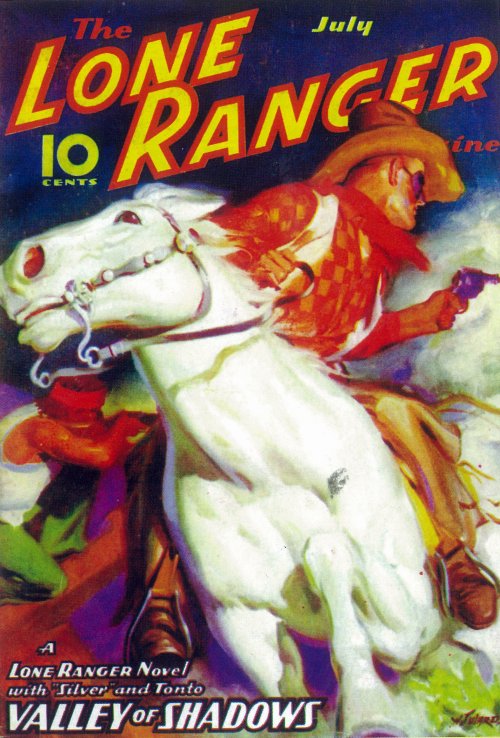
Hugh Joseph Ward (1909-1945) painted many of the most sensational pulp magazine covers that ever graces a sidewalk newsstand and stopped a pedestrian dead in his tracks. He painted sexy women hounded by ferocious predators, whose merciless villainy is only matched by their shocking lack of chivalry. His work as fascinated generations of fans, but his life has remained a mystery ever since his untimely death at the age of 35, while serving in WWII.

August 1940 issue, H.J. Ward cover.
Thankfully, a friend of mine named David Saunders has written an insightful biography, richly seasoned with quotes from the artist and his associates, that chronicles the life and art of this important American master of 20th century popular culture. For fans of Ned Jordan, Secret Agent, Superman, The Lone Ranger and The Green Hornet, this book is a treasure trove.

The book, simply titled, H.J. Ward, reveals the life of the man behind so many masterpieces of pulp art. It chronicles his humble family roots, his art education, and his early career as a newspaper cartoonist. The artist's methods are documented along with his impressive contributions to the earliest conceptualizations of America's famous super heroes -- The Lone Ranger, The Green Hornet, Ned Jordan, Kato, Judy Medwick, and Superman.

While I did not count them, I estimate over 500 high quality reproductions of pulp art are included in this large coffee table sized book. Over 100 original paintings, 80 conception drawings, and 50 historic photographs, along with a comprehensive checklist of all published illustrations are included. That means if you want to see conception sketches of Kato (from The Green Hornet) in the livery stable working on the Black Beauty, an oil painting that was never made, this is your chance to see the proposed art work. 

Lone Ranger pulp magazine
My favorite is on page 120. Graphite on paper, a preliminary drawing for The Lone Ranger "fan photo." Turns out, the art work was commissioned and used for tons of radio and newspaper advertisements, the cover of The Lone Ranger and the Menace of Murder Valley (Big Little Book from 1937), a promotional booklet from 1938, and other examples all pictured splendidly for all to gather an excellent example of how such oil paintings were put to use.

In fact, there is an entire chapter devoted to The Lone Ranger, another chapter devoted to The Green Hornet, another for Superman, and well... you get the idea. For fans of these classic icons, this book offers rare glimpses of materials you would never have gotten the privilege to see otherwise. And it's books like David's that makes us grateful that such documentation has finally become available.

One of the more amusing facts I learned from reading the book was that Ward used his wife to model for many of the damsels in distress. This might explain why the women in his oil paintings appear to look the same.

And how did David manage to mass such a large collection of high-quality scans and photos for the book? All the biographical material and family portraits of Ward? The family of the artist, of course, who welcomed David into their homes for countless hours of research and interviews. This was a rare opportunity and a privilege, since many family relatives of famous pop culture icons have been taken advantage of. Just last year I was in the Midwest browsing photographs, newspaper clippings and tons of archival material, in the home of the son and daughter of a famous radio script writer. Sadly, they opened their doors and hearts to others in the past and little (if anything) was ever done. Firsthand, I can understand why family relatives don't often allow strangers or historians into their homes and David fulfilled his promise to immortalize H.J. Ward in a book that was lovingly produced with a passion to ensure the best job possible.


If the author, David Saunders, sounds familiar, it should. Not only did he deliver a slide show presentation on H.J. Ward at the fifth annual Mid Atlantic Nostalgia Convention, but his father was the great Norman Saunders, a pulp artist who provided strikingly good images for pulp magazine covers, paperbacks, pre-code comics, Men's magazines, Mars Attacks and Wacky Packs. David wrote a book about his father, in the same manner as the H.J. Ward book, available from the same publisher.

Speaking of H.J. Ward, Eric Roberts is seeking to buy prime examples of Hugh J. Ward's artwork, as well as original paintings from Saunders, Finlay, Desoto, Brundage, Bergey, Parkhurst and Schomburg. For more info, call Eric at 650-814-9196, or e-mail him at plastered_peanuts@yahoo.com or visit his web-site, www.triksr4kids.com.

February 1940 Spicy Mystery cover art.

The people responsible for the publication of both the Norman Saunders and H.J. Ward books is The Illustrated Press, Inc. They have a superb magazine that is (to my knowledge) the only periodical dedicated to the history of American illustration art. Issued quarterly and printed in full-color on the finest paper stocks (which means these are high-quality, expensive printings), Illustration is a beautiful source for new information on the great illustrators of the past. Each issue is a reference book in itself. Subscription rates are $60 (postpaid) per year. 3640 Russell Boulevard, St. Louis, MO 63110. Their web-site, should you want to view every page of their latest issue, is www.illustration-magazine.com.

Information on how to purchase copies of the Norman Saunders and/or H.J. Ward books can be found at www.TheIllustratedPress.com, or the same St. Louis address listed above. I recommend you buy the book direct from the publisher because it helps support such efforts. Buying a copy from Amazon.com or your favorite book store will only save you a dollar or two, but eliminate almost any profit margin for the men responsible for making these books available in the first place.

Friday, August 26, 2011

Science Fiction Theatre: The Pilot

William Lundigan needs rest in the episode "Beyond."
From 1954 to 1957, ZIV-TV and Ivan Tors produced a series of science fiction dramas titled Science Fiction Theatre. Hosted by Truman Bradley, this anthology with a strong emphasis towards science than fiction, is considered by many as one of the five best science-fiction television programs ever broadcast on American television.

To get the series launched off the ground, Ivan Tors and his crew devoted more energy towards not one but two pilots, “Beyond” and “Y**O**R**D**,” than any other episodes of the series. 

The first of the two pilots, “Beyond,”concerned a test pilot flying with twice the speed of sound and meets a torpedo-shaped flying object 30,000 feet high in the sky. Afraid of collision, the pilot bails out. Medical experts suspect that his sighting was nothing but a visual hallucination and he is subjected to a lie detector test, hypnosis and various mental and physical examinations. In the meantime, retracing the curve of the test flight, some prominent scientists arrive at the conclusion that the angle and the speed of the ascent equalized the Earth’s gravitational pull with the result that the pilot’s brain was floating inside his skull. They conclude that the effect of this unusual condition was the misinterpretation of a floating fountain pen inside the cockpit. The pilot insists he was not hallucinating, but his insistence is met with opposition. When pieces of the wrecked airplane are recovered in the desert, the metal is highly magnetized, indicating that the plane brushed against something traveling through the atmosphere powered with magnetic force. Was it a spaceship, a flying saucer or a monitoring instrument from outer space? Only science and tomorrow will tell.

The pilot episode was produced in July of 1954, with William Lundigan in the lead as Fred Gunderman and Ellen Drew as his wife. It comes as no surprise that Lundigan, having played the lead in Tors’ Riders to the Stars less than a year previous, would star in the pilot. Tors had struck up a friendship with the actor and his agency, Famous Artists, who secured the arrangements for casting. Tors then assembled a staff composed of many who worked on his three motion pictures. Scientific advisor Maxwell Smith agreed to assist with the pilot and the entire series. George Van Marter, who was the art director for The Magnetic Monster, was hired on a free-lance basis to temporarily serve as a writer for the first two episodes. “Beyond” concerned a test pilot who may or may not have encountered an unidentified flying object with baffled scientists unable to find definite proof that his story was merely a hallucination. “Y**O**R**D**” (that's how it's spelled on the screen) concerned a group of scientists stationed in the Arctic who receive telepathic communication from visitors from outer space, seeking a means of escape from the planet’s gravitational pull.

Ellen Drew and William Lundigan
“Beyond” and “Y**O**R**D**” were both produced at American National Studios. While Tors had the Hal Roach Studios at his disposal (the same studio responsible for producing You Are There and My Little Margie), it was Ziv who insisted that production be kept at American National to limit the expenses.

Made at the same time as producer Art Arthur’s Battle Taxi, Ivan Tors borrowed some of Arthur’s production staff to assist with the pilot for Science Fiction Theatre. A clause in the contract protected ZIV-TV with an option to reject the proposal should he deem the pilot insufficient.

Art Arthur was responsible for Battle Taxi, released theatrically in January of 1955, which had a working title of “Operation Air Rescue” during production in the summer of 1954. The movie (assigned Prod. No. 9941) took place during the Korean war, and told the story of the commander of an Air Rescue helicopter team who must show a hot-shot former jet pilot how important helicopter rescue work is and turn him into a team player. The pilot, “Beyond,” had Prod. No. 9072, revealing that production numbers were not assigned in sequence.

Herbert L. Strock, who directed Battle Taxi, also directed the pilot. “I felt that Ivan had a fetish for doing scientific things that an audience didn’t understand,” Strock recalled in the March/April 1996 issue of Filmfax. “He would lose the human element—emotions that were going on—and get into technicalities. I had to constantly bandy him to try to change something that had meaning. He wasn’t very good at dialogue; his physical dialogue had that European convolution of expressing oneself.”

Strock was served as an associate producer for a number of television programs and movies before script clerk Mary Whitlock Gibson recommended him for the job of both editor and director, filling in for director Curt Siodmak, who was disappointing Tors. As a film editor, Strock knew how to best incorporate stock footage into newly filmed footage. For Tors’ second film, Riders to the Stars, also scripted by Curt Siodmak, Strock became an associate producer and soon found himself taking over as director when Richard Carlson overextended himself by directing, acting and rewriting the film. It started when Carlson asked Strock to direct the scenes he acted in, and Strock quickly took over the task for the remainder of the film. Strock remains un-credited for both movies as director.

Herbert L. Strock would continue to go silent as a ghost director for Science Fiction Theatre, directing a large handful of the first season opening and closing segments featuring Truman Bradley, which were filmed separately from the dramatic stories.

“Curt and Ivan disagreed constantly, there’s no question about that,” recalled actor Michael Fox. “And Curt’s knowledge of directing was, in my opinion, not particularly great. Curt’s brother Robert was an extremely successful director, and I think Curt—who certainly ranks very highly among screen-writers—always was somewhat envious of Robert.”

Beverly Garland on Science Fiction Theatre
 Also joining the Theatre troupe was Harry Redmond Jr. as a special effects technician. Redmond’s father had worked during the years of silent cinema and quickly rose in the ranks to special effects supervisor for RKO Studios. He taught his son the craft while working together for The Princess and the Pirate (1944) and The Secret Life of Walter Mitty (1947), the latter of which was the senior’s final contribution to Hollywood, passing on the torch to his son.

Redmond quickly jumped into television with Dangerous Assignment before moving on to Ziv Television at the request of Ivan Tors. It was Redmond who succeeded in bringing Donovan’s brain to life in 1953, and the skilled elements that made up Ivan Tors’ three former science fiction motion-pictures. Many of Redmond’s personal props that appear in Donovan’s Brain (1953), such as test tubes, water tanks, lab equipment, Oscillograph and scientific charts hanging on the wall, make reappearances in numerous Theatre productions. After production of Science Fiction Theatre concluded, Redmond would stay with the studio to help assist with Sea Hunt, The Man and the Challenge, The Aquanauts and then concluded at the peak of his career with the first season of The Outer Limits from 1963 to 1964.

It was Redmond’s balanced magnetic field that holds the ball bearing in mid-air as demonstrated by Truman Bradley in “Beyond.” The same prop can be seen on Bradley’s desk at the close of “Beyond” and “Y**O**R**D**” and the lab demonstration for the U.S. military in one key scene of Earth vs. the Flying Saucers (1956).

“Beyond” was conceived by Ivan Tors and scripted by Robert Smith and Van Marter. On April 13, 1954, Maurice Unger at ZIV consulted Tors regarding the story premise, temporarily titled “Saucer,” offering insight into story structure since television production required careful plotting and pace. The exposition, rising action, climax, falling action and concluding with dénouement, catastrophe or resolution.

“Generally speaking, the first thirteen pages seems to be about right, but we have decided that in some manner we must get the story started from Fred’s point-of-view,” Unger wrote. “One suggestion in this connection is to have a short scene in or around the control room where Fred is receiving a last-minute briefing and also is getting into his latest model, highly technical gear. We establish who he is and the purpose of his flight. If we handle it in this matter, it would be well to give Fred the bulk of the dialogue because at this point it is Fred in whom we are interested.”

Another suggestion was to do a complete switch in point-of-view and play the second half of the story to an ending completely from the point-of-view of the General and the scientist. Also suggested was the questioning. “When the matter is being discussed we must knock out the possibility of everything that is suggested such as another one of our planes, an enemy plane, a guided missile, atmospheric reflections, etc. We also have to set up some reason why, if the General knew that Fred saw something in the sky, he felt it necessary to convince Fred that he didn’t.” Another suggestion was to retain the computers but remove all company logos that might be misinterpreted as product placement, including IBM.

John Archer on Science Fiction Theatre
On May 28, 1954, after reviewing the revised script, Unger offered a number of other suggestions for improvement. Among these was suggesting the television audience catch more glimpses of Fred Gunderman before take-off, particularly seeing his face before he put on his flying helmet, “otherwise we’ll never recognize his face when we see it in the hospital.” Another suggestion was to not mix dialogue and narration. Fading out the dialogue as the narrator overtakes the soundtrack was considered a no-no. “Once the narration stops, leave it out of the scene until all the dialogue has been completed.” This explains why Truman Bradley’s off-screen narrations overlaps only visual scenes but not verbal throughout the series.

On June 19, 1954, just a couple weeks before the pilot went before the cameras, Maurice Unger of Ziv Television Programs, Inc. submitted Ivan Tors with a list of nine names for the lead role in “Beyond.” Gary Merrill, Frank Lovejoy, Robert Preston, Steve McNally, John Lund, Howard Duff, Lloyd Bridges (who was not yet starring in Sea Hunt), William Lundigan and John Ireland. Dane Clark and Scott Brady were also up for consideration but were quickly ruled out. Tors replied back to Unger with three names, Frank Lovejoy, John Lund and William Lundigan with Lovejoy being his top preference and John Lund second. “Of course, my suggestions might not be in line with what the sponsors want,” Tors explained. “My yardstick is acting ability in these selections.”

Truman Bradley relaxing at the desk in between takes.
Perhaps the most significant casting was actor and dialogue director Michael Fox. Known today as a character actor in more than 200 television and motion pictures and the reason why actor Michael J. Fox (Back to the Future) inserted a middle initial in his name. Having played the role of doctors in The Magnetic Monster (1953), The Lost Planet (1953), Beast With 20,000 Fathoms (1953), Riders to the Stars (1954) and Gog (1954), he built a friendship with Ivan Tors. “While I was doing Home of the Brave [an acting-directing stint in a Players Ring production], Ivan Tors also had come to see the play,” Fox recalled for author/interviewer Tom Weaver. “Ivan and I became very good friends. Ivan was then wooing Constance Dowling, later they married, and Constance and [her actress-sister] Doris and I all became extremely good friends.” As a result, Fox secured acting jobs for seven episodes of Science Fiction Theatre, six of which he played the role of a doctor. (His only non-doctor role was that of a radar man in the “Beyond” pilot.)

The first two episodes produced, “Beyond” and “Y**O**R**D**,” were learning experiences for both Bradley and the technical crew. Inter-office memos debated whether or not he was allowed to wear his ring on the pinky finger of his right hand, because a number of insert shots might require a stand-in to use his hand and therefore, the need of a ring to be worn as well to match. It appears the decision to remove the ring was discarded since he wears the ring throughout the first season.

Bradley’s wardrobe, however, became an issue that was quickly resolved when Maurice Unger viewed the rough cut for “Y**O**R**D**,” and discovered that Bradley’s tie was a solid red before the drama but the closing scene with Bradley at his desk, inviting the viewers to return again next week, was polka dotted. When Bradley had been filmed for “Beyond,” he wore a polka dot tie and his closing invite was purposely filmed with no commentary so the closing minute (which contained the cast and crew credits) would be reused for all of the episodes—a cost saving device that was used for the closing of “Y**O**R**D**” and Unger’s disappointment. 

Truman Bradley
On December 10, Unger sent both Ivan Tors a memo requesting the closing shot be re-filmed with a striped tie, and beginning with the third episode put before the cameras, Bradley would officially wear a striped tie. On the morning of February 28, 1955, Bradley reported to stage 6 at American National to film the lab demonstrations (known as pickups) for episodes 3, 4 and 5, and wore the striped tie as requested. But he wore a textured suit, tan in color, which went overlooked until after the rushes were viewed. Fearing the cost to re-film, these episodes feature Bradley wearing the tan colored suit. (Only the first five productions were filmed at American National.)

On the afternoon of March 14, Bradley reported to the set at Ziv Television Studios wearing a dark blue suit, for productions 6 and 7. By this time a script had been written: “I hope you enjoyed our story. We’ll be back with you a week from today with another exciting adventure from the world of fiction and science. Until then, this is your host, Truman Bradley, saying . . . see you next week.”

The closing scene was filmed on this date and again Unger viewed the rushes and requested Bradley wear the dark suit from now on. Observant television viewers will note that with the exceptions noted above, Bradley always wore a striped red and white tie and a dark blue suit.

Shortly after the initial telecast, Variety reviewed this episode in their April 13, 1955 column: “There’s too much science and too little fiction in the opener of ZIV’s new series. It was a smart move on ZIV’s part to start an offbeat series in a market glutted with imitations, but the show will have to be much better than the tee-off stanza to hold an audience. Semi-documentary approach is used, or mis-used, to put it more accurately. Narrator Truman Bradley gives little lectures on science both before and after the picture, thus leaving only about 20 minutes for the telling of the yarn. This leaves little time for proper building up of characterizations or situations... Viewer is told what is happening and while this might be fine for radio, on TV it is a dud. Scientists figure out pilot actually saw his fountain pen suspended in weightlessness, but later on there’s proof he probably did see an unidentified object which might have been a platter. Ivan Tors, the pix producer, is making this series for Ziv as his TV debut. His first shot is a disappointing one, particularly in view of the unlimited horizons for a different kind of series such as scientifiction.”

Episode #1 “BEYOND”
Production #1001 / 1B
Dates of Production: July of 1954
Directed by Herbert L. Strock

Script & Story
Teleplay by Robert Smith and George Van Marter, from a story by Ivan Tors.

PRODUCTION CREDITS
1ST ASST. CAMERAMAN: Dick Rawlings (un-credited)
1ST CO. GRIP: Mel Bledsoe (un-credited)
2ND ASST. CAMERAMAN: Jack Kenny (un-credited)
2ND ASST. DIRECTOR: George Loper (un-credited)
2ND CAMERAMAN: Monk Askins (un-credited)
2ND CO. GRIP: Walter Culp (un-credited)
ART DIRECTOR: William Ferrari
ASSISTANT DIRECTOR: Joe Wonder (credited) and Donald Verk (un-credited)
ASST. FILM EDITOR: George Reid (un-credited)
ASST. PROP MAN: Sam Heiligman (un-credited)
BEST BOY: Lotus Davidson (un-credited)
BOOM MAN: Elmer Haglund (un-credited)
CABLEMAN: J.R. McDonald (un-credited)
CAMERA OPERATOR: Lee Davis (un-credited)
CASTING: Patricia Harris (un-credited)
CONSTRUCTION CHIEF: Archie Hall (un-credited)
DIRECTOR OF PHOTOGRAPHY: L.B. Worth
EXECUTIVE PRODUCTION SECRETARY: Bea Lisse (un-credited)
FILM COORDINATOR: Donald Tait
FILM EDITOR: Charles Craft, a.c.e.
GAFFER: Joseph Wharton (un-credited)
MAKE-UP ARTISTS: George Gray (un-credited) and Harry Thomas (credited)
PROPERTY MASTER: Charles Henley (credited) and Lyle Reifsnider (un-credited)
PUBLICITY: Frank Perrett (un-credited)
RECORDER: Bob Post (un-credited)
SCRIPT SUPERVISOR: Jack Herzberg
SECRETARY: Constance Morris (un-credited)
SET DRESSER: Lou Hafley (un-credited)
SET LABOR: Felex Caelecia (un-credited)
SOUND MIXER: Jack Goodrich (credited) and Gary Harris (un-credited)
SPECIAL EFFECTS DIRECTOR: Harry Redmond Jr. (un-credited)
STILL MAN: Bill Thomas (un-credited)
WARDROBE: Paul McCardle

CAST: Bruce Bennett (General Troy, $750); Robert Carson (Captain Ferguson, the security officer, $70); Tom Drake (Dr. James Everett, $500); Ellen Drew (Helen Gunderman, $750); Michael Fox (the radar man, $70); Douglas Kennedy (Colonel R.J. Barton, $300); Mark Lowell (the switch board operator, $70); William Lundigan (Major Fred Gunderman, $1,500); and Basil Ruysdael (Prof. Samuel Carson, $300).
Talent fee salaries are listed next to the corresponding actors.

NOTES
-- The closing credits of every episode acknowledged Ivan Tors being “in charge of production.” This is the only episode of the series that acknowledges his middle initial, “Ivan L. Tors.”
-- Because this episode was constructed as a pilot and not produced with the remaining 38 episodes of the season, Truman Bradley’s laboratory set was different from the set seen in the remaining first-season episodes, including different props along the wall during the initial pan and scan. This was also the only episode to feature the ZIV Television logo in color.
-- The square glass wall surrounding the doorway in the professor’s room was the same one featured prominently in the 1954 movie Gog.
-- Truman Bradley’s introduction for this episode, as verified by the script, was originally intended to open with Bradley in a dark room. The cameraman was then instructed to change the lenses by placing a tube in front of the camera showing Bradley standing in the center of the screen, revealing an instrument developed by the Defense Department to find targets in the night. Instead, the opener features the camera pointed directly to Bradley’s chair and Bradley speaks offcamera before finally walking into the frame. The remaining scenes were filmed as instructed, revealing a number of demonstrations of how the human eye could not see what was clearly there.
-- Eddie Davis directed Truman Bradley for the opening and closing lab demonstrations on Sept. 11, 1954, as well as the introductory pan and scan of the lab that was intended for the opening and closing on-screen credits. This pan and scan, however, was discarded for a revised pan and scan filmed when Bradley’s lab was reconstructed (with revisions) six months later for the production of the remaining 38 episodes.
-- Props featured in this drama would be reused repeatedly throughout numerous episodes of Science Fiction Theatre including the speaker in the Operation Center and the textured painting of the solar system hanging on the wall in the professor’s office.
-- The Eastman Kodak company provided the stock footage of the slow motion effect of the bullet hitting the glass. Every episode of the first season was filmed on Eastman Kodak color film.
-- A poster mapping out the layers of Earth’s atmosphere hangs on the wall in two separate rooms in two separate scenes in this same episode! This is the same poster that would appear on the wall in numerous episodes such as “Project 44,” “Postcard From Barcelona” and “Hour of Nightmare” and the wall of Truman Bradley’s laboratory during the initial opener of every episode, located behind the oscillator cone.
-- After the initial filming for this pilot was completed, Bruce Bennett insisted on having the same identical billing that William Lundigan received — Equal size and position on the screen. ZIV-TV obliged to please both actors, but when Basil Ruysdael insisted on first feature billing, this posed a problem. Ruysdael only had a brief scene in the entire episode. ZIV’s solution was to give him top billing on the list of supporting cast (not the lead stars). Ruysdael was not satisfied when he learned about the arrangement, threatening in a letter never to endorse Science Fiction Theatre. This may explain why he never appears in any other episode of the series.  
-- The footage of the white mice in the weightlessness of space would be reused for the episode “Marked Danger.”
-- The scene of the missile launching into the Earth’s atmosphere in this episode utilizes the same stock footage that appears in “The Strange People at Pecos” and the same footage that closed the movie Gog (1954).

The information contained on this page originate from the new book, Science Fiction Theatre: A History of the Television Program, 1955-57, by Martin Grams Jr. This is one of the latest books to come from Bear Manor Media, published in late 2010.

The information contained on this page was reprinted with permission from both the author and the publisher. If you know of anyone interested in the book, or want to help spread the word, click on the photo for an enlarged copy and right click to save the image.

For more information about the book, visit www.MartinGrams.com